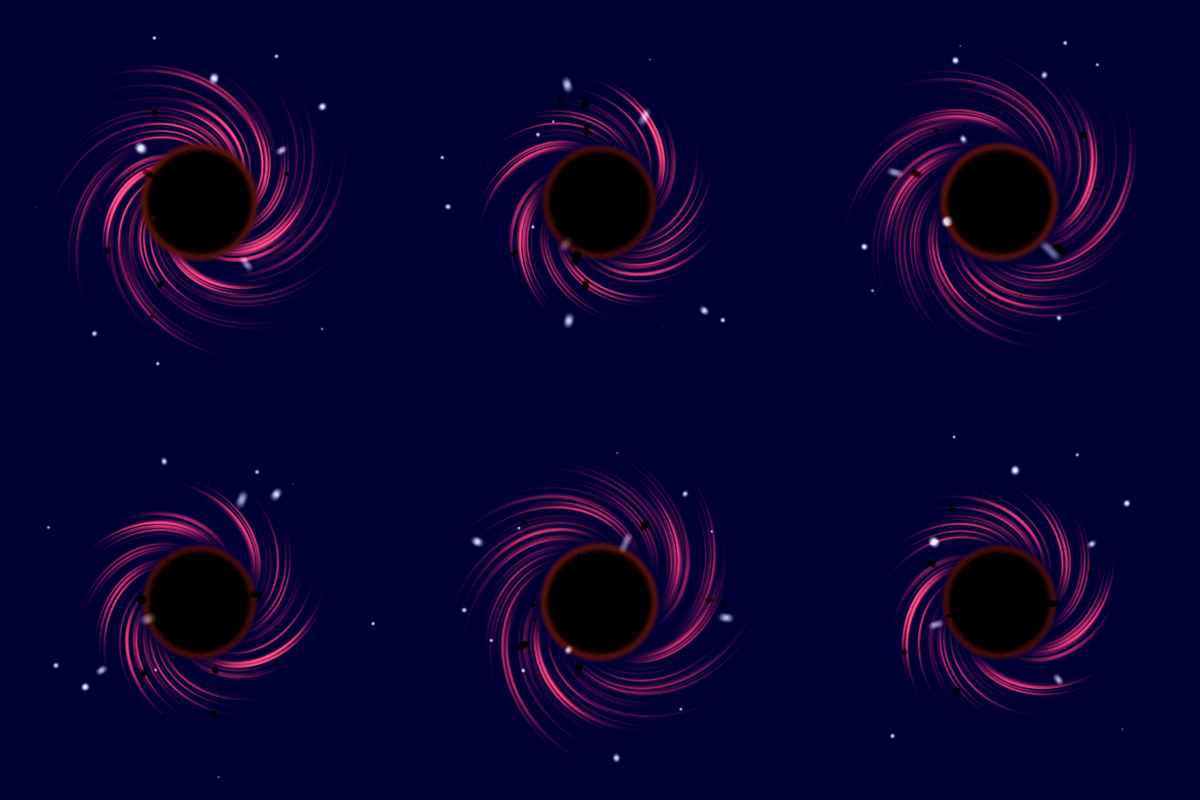
A black hole is simply an object from which light can’t escape. If particles of light (photons) cannot escape the surface of the object, then we can’t see the object - hence the name.
 |
|---|
| A black hole. |
They can be formed from the gravitational collapse of massive stars but are also of interest in their own right, independently of how they were formed.
 |
|---|
| Life cycle of a star. |
Far from being hungry beasts devouring everything in their vicinity as shown in popular culture, we now believe certain (supermassive) black holes actually drive the evolution of galaxies.
 |
|---|
| The first ever image of a black hole at the heart of the M87 galaxy taken in April 2019. |
At the centre of our own galaxy, the milky way, the supermassive black hole is called Sagittarius A* and has a mass of about 4.3 million times the mass of our Sun.
 |
|---|
| Orbit of stars around the central black hole, Sagittarius A.* |
 |
|---|
| The second ever image of a black hole, Sagittarius A, at the heart of our own galaxy, taken in May 2022.* |
The first person to come up with the idea of a black hole was John Michell in 1783, followed (independently) by Pierre-Simon Laplace in 1796. These prototypical black objects, called ‘dark stars’, were considered from the point of view of Newton’s law of motion and gravitation.
In particular, Michell calculated that when the escape velocity at the surface of a star was equal to or greater than lightspeed, the generated light would be gravitationally trapped, so that the star would not be visible to a distant astronomer.
The event horizon is the boundary of this region, also known as the ‘point of no return’ because once you go past this point it is impossible to turn back.
 |
|---|
| The black hole region. |
Black holes also arise as solutions in Einstein’s theory of general relativity. The first such solution was found by Karl Schwarzschild in 1916 and called the ‘Schwarzschild solution’. It was originally formulated in order to describe the gravitational field of the solar system, and to understand the motion of objects passing through this field, but the idea of a black hole remained as an intriguing possibility.
The first black hole candidate was discovered in 1964 and called Cygnus X-1. Its mass was long quoted as around 14.8 times that of the Sun, but a 2021 re-measurement of its distance revised this upwards to roughly 21 solar masses.
 |
|---|
| Cygnus X1 is a galactic X-ray source discovered during a rocket flight. |
How do we know they are really there?
For most of the twentieth century black holes were a theoretical curiosity — solutions to Einstein’s equations that many physicists, Einstein included, doubted described anything real. Three independent lines of evidence changed that, and all three matured within the last decade.
Stellar orbits. Tracking individual stars whipping around the galactic centre for nearly thirty years showed them orbiting something with millions of solar masses packed into a region smaller than our solar system. Nothing else can do that. This work won Reinhard Genzel and Andrea Ghez a share of the 2020 Nobel Prize in Physics, alongside Roger Penrose, whose 1965 singularity theorem showed that black hole formation is a robust prediction of general relativity rather than an artefact of assuming perfect symmetry.
Gravitational waves. When two black holes merge they radiate ripples in spacetime itself. LIGO’s first detection in 2015 was of a merger a billion light years away; the fourth observing run (O4), which ran from May 2023 to November 2025, was picking up a coalescence every two to three days. The GWTC-5.0 catalogue, released in 2026, brought the running total to around 390 detected signals. A field that had zero data points in 2014 now has a population to do statistics on.
Direct images. The Event Horizon Telescope images shown above are, strictly, images of the light bent around the hole rather than of the hole itself — the dark centre is the shadow cast on the surrounding glow.
Recent developments
The two headline images above are no longer the state of the art:
- M87* changed. Comparing the 2017 and 2021 observations, the EHT found the polarisation pattern around M87* had flipped direction — described by the collaboration as completely unexpected. Polarisation traces the magnetic field structure, so this is direct evidence that the magnetic environment just outside the horizon is dynamic rather than static.
- The jet base was pinned down. In January 2026 the EHT and ALMA traced M87’s 3,000-light-year jet back to a compact source roughly 0.09 light years from the black hole. The ring of light alone could not account for all the radio emission — something else, at the expected launching point of the jet, does.
- Sharper, and in colour. New detections at higher observing frequencies have reached resolutions as fine as 19 microarcseconds, which should make future images around 50% crisper and, by combining frequencies, produce the first multi-wavelength views of the region just outside a horizon.
- A sleeping giant next door. In April 2024, ESA’s Gaia mission found Gaia BH3, a 33-solar-mass black hole about 1,900 light years away — by far the most massive stellar black hole known in the Milky Way, and found not by its X-rays but by the wobble it induces in an orbiting companion star. Its mass sits right in the range of the black holes that LIGO sees merging, which is the first direct link between the two populations.
Where my own research fits
Everything above is observational. My own work sits at the other end of the problem: what the mathematics of black holes looks like when you take supersymmetry and string theory seriously.
The key object is the near-horizon geometry — zoom in on the event horizon of an extremal (maximally spinning or maximally charged) black hole and the geometry settles into a limiting form that can be studied on its own terms. My PhD thesis showed a striking rigidity there: for supersymmetric black holes in various supergravity theories, the amount of supersymmetry preserved at the horizon is always double what you would naively expect. The horizon is more symmetric than the black hole it belongs to. This is the horizon conjecture, and the thesis proved it for several theories.
I have recently returned to this. Two 2026 papers extend the programme in ways I have written up for a general audience in a separate post:
- one shows that the “warp factor” describing how time is stretched near a horizon in eleven-dimensional supergravity is rigidly constrained — checking it at a single point is sometimes enough to pin down the entire spacetime;
- the other proves that a class of five-dimensional supersymmetric black holes must have an extra rotational symmetry nobody assumed, and uses that to rule out a shape — a supersymmetric “black ring” with varying moduli in anti-de Sitter space — that people had been looking for.
None of this will be tested by the Event Horizon Telescope any time soon. But it is the same question the observers are asking, approached from the far side: what can a black hole be?